
Table of Contents
- Why Buy Ethically Produced Minimalist Clothing in 2026
- Sustainable Capsule Wardrobe Essentials for Every Climate
- How to Identify Ethical Clothing Brands You Can Trust
- Materials That Matter: Natural Fibers vs Synthetics
- Cost-Per-Wear: The Real Math Behind Ethical Fashion
- Caring for Your Minimalist Wardrobe: Mending and End-of-Life
- Frequently Asked Questions
Last Updated: September 13, 2026
Why Buy Ethically Produced Minimalist Clothing in 2026
Choosing to buy ethically produced minimalist clothing is a deliberate shift away from trend-driven consumption toward garments with measurable longevity and traceable origins. At Hels1nk1, we see this shift firsthand among conscious shoppers who want fewer, better pieces that survive both changing seasons and changing bodies.
The case for slow fashion rests on something more durable than a seasonal trend: cost per wear. A garment worn 150 times costs a fraction per outing of one worn five times, regardless of the sticker price. Many conscious consumers in Luxembourg and across Europe now weigh purchases this way, treating each item as an investment rather than a disposable.
Below, we break down how to build a sustainable capsule wardrobe essentials list, how to identify ethical clothing brands without falling for marketing language, and how to keep every piece in rotation for years rather than months.
Sustainable Capsule Wardrobe Essentials for Every Climate
A sustainable capsule wardrobe is a small, coordinated collection of versatile basics designed to be worn repeatedly across seasons and occasions. A typical capsule runs 25 to 40 pieces, each chosen for fit, fabric quality, and how well it combines with everything else you own.
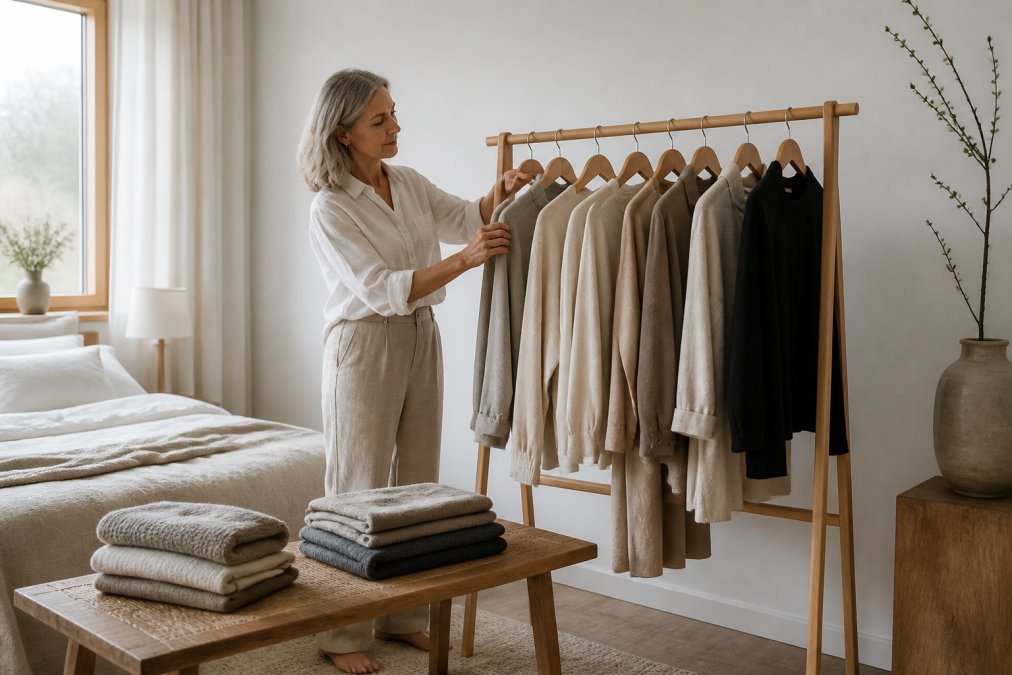
The right essentials depend heavily on where you live, since climate dictates what actually gets worn.
Cold Climate Essentials
For cold seasons, prioritize layering pieces that work indoors and out: merino wool base layers, a heavyweight knit, wool trousers, a long coat, and sturdy leather boots. Natural fibers like wool and hemp regulate temperature better than synthetics and hold up to repeated wear.
Warm Climate Essentials
Warmer seasons call for breathable, lighter fabrics: linen shirts, organic cotton tees, a mid-weight overshirt for evenings, and one versatile dress or trouser that moves between casual and professional settings. Tencel and linen handle heat without clinging, and both age well with proper care.
Climate |
Core Pieces |
Key Fibers |
Layer Strategy |
|---|---|---|---|
Cold |
Wool coat, knit, base layers |
Merino, hemp, wool |
Three-layer system |
Warm |
Linen shirt, cotton tee, dress |
Linen, organic cotton, tencel |
Light, breathable single layers |
Temperate |
Overshirt, trousers, cardigan |
Cotton, wool blends |
Two-layer flexibility |
How to Identify Ethical Clothing Brands You Can Trust
Verifying an ethical clothing brand comes down to evidence, not adjectives. Look for specific, checkable claims: named factories, published supplier lists, certification logos, and clear statements about where materials originate. Vague language like "eco-friendly" or "conscious" without supporting detail is a warning sign.
European Commission guidance on green claims has tightened scrutiny on unverified environmental marketing, which means brands making sustainability claims now face real accountability in the EU market.
Supply Chain Transparency Tiers
Not all transparency is equal. We group brands into three practical tiers:
- Tier 1 (Full traceability): Publishes named suppliers, factory locations, and material origins, often down to the farm or mill level.
- Tier 2 (Partial disclosure): Shares country-level sourcing and some supplier names but stops short of full traceability.
- Tier 3 (Claims only): Uses sustainability language with no verifiable supply chain detail.
Aim for Tier 1 or Tier 2 brands, and treat Tier 3 claims with skepticism until you can verify them independently.
Red Flags of Greenwashing
Watch for these signals: certification logos that don't link to a verifiable registry, "sustainable" collections that sit alongside fast-turnover drops, and a focus on a single eco-friendly material while ignoring labor practices. Genuine ethical brands tend to talk as much about people and supply chain traceability as they do about fabric.
Materials That Matter: Natural Fibers vs Synthetics
Fiber choice shapes a garment's carbon footprint, comfort, and lifespan more than almost any other factor, and it is the single easiest thing to check on a label before you buy. The practical split is between natural fibers (plant- and animal-based), regenerated cellulosics (wood-pulp based), and synthetics (petroleum-based).
Natural fibers. Organic cotton, linen, hemp, and wool biodegrade at end of life and regulate temperature well. The trade-offs are real: conventional cotton is water-intensive, wool production can involve land-use and animal-welfare questions, and natural fibers generally wear out faster under heavy abrasion than synthetics. Look for third-party verification rather than brand adjectives, GOTS for organic cotton and wool processing, RWS (Responsible Wool Standard) for wool, and Oeko-Tex Standard 100 for chemical safety on the finished fabric.
Regenerated cellulosics. Tencel (branded lyocell), modal, and viscose come from wood pulp. Tencel's closed-loop lyocell process recovers most of the solvent, which is why it is often cited as the lower-impact option in this category; conventional viscose uses a more chemically intensive process and is worth questioning unless the brand names its supplier. These fibers drape well, resist wrinkling, and suit warm climates, but they can pill and are less abrasion-resistant than cotton or wool.
Synthetics. Recycled polyester (often labeled rPET) diverts plastic waste from landfill and is durable and quick-drying, which is why it dominates activewear. The catch is that all polyester, recycled or virgin, sheds microplastics during washing, and recycled content does not make a garment biodegradable at end of life. If you buy synthetics, a Guppyfriend wash bag or a filter-equipped washing machine reduces what reaches waterways.
Where regenerative agriculture fits. A growing share of cotton and wool is now sourced from regenerative systems that prioritize soil health, water retention, and biodiversity over maximum yield. Textile Exchange materials market data tracks how these fibers are produced and certified across global supply chains, and is the most reliable public reference for comparing fiber volumes year over year.
Two more markers worth knowing. Low-impact dyes reduce water pollution during production, and deadstock fabric repurposes surplus material that would otherwise be discarded. Neither guarantees an ethical supply chain on its own, a brand can use deadstock fabric sewn in an unverified factory, but both signal a brand thinking beyond surface aesthetics.
Fiber |
Typical strengths |
Typical trade-offs |
Certification to look for |
|---|---|---|---|
Organic cotton |
Breathable, biodegradable, versatile |
Water-intensive; slower to dry |
GOTS |
Linen / hemp |
Durable, temperature-regulating, low-input crops |
Wrinkles easily; limited color range |
European Flax, OCS |
Wool / merino |
Warm, odor-resistant, long-lasting |
Animal welfare and land-use concerns |
RWS, ZQ |
Tencel / lyocell |
Soft drape, closed-loop processing |
Pills; less abrasion-resistant |
FSC-certified pulp |
Recycled polyester |
Durable, quick-drying, diverts plastic waste |
Sheds microplastics; not biodegradable |
GRS |
Cost-Per-Wear: The Real Math Behind Ethical Fashion
Cost-per-wear is calculated by dividing a garment's purchase price by the number of times you actually wear it. A higher upfront price often wins this equation because well-made pieces stay in rotation far longer than cheap alternatives that lose shape or color within a season.
Run the numbers before you dismiss a piece as too expensive. A coat worn three times a week for two winters beats a cheaper jacket replaced every year, both financially and environmentally. This is the core argument for quality over quantity, and it's the calculation that makes slow fashion practical rather than aspirational.
Ellen MacArthur Foundation circular economy research shows that extending a garment's active life is one of the most effective ways to reduce its overall environmental impact.
Caring for Your Minimalist Wardrobe: Mending and End-of-Life
Garment care and longevity are where most capsule wardrobe guides stop short, they tell you to buy less, then leave you without a plan for the years that follow. Extending a garment's active life is one of the highest-leverage sustainability moves available to an individual, and it costs far less than replacing the item.
Care mechanics that actually extend life
- Wash less, air more. Most knitwear and outerwear do not need washing after every wear. Airing a garment overnight on a hanger eliminates odors and lets fibers recover their shape. Spot-clean stains immediately rather than running a full cycle.
- Wash cold, inside out, on a gentle cycle. Heat and agitation are what break down fibers and fade dye. Turn garments inside out to protect the surface, and use a mesh laundry bag for knits and anything with buttons or zips.
- Skip the dryer. Air-drying prevents shrinkage, pilling, and elastic breakdown. Lay knitwear flat to dry so it does not stretch on a line.
- Fold knits, hang wovens. Hanging a heavy sweater distorts shoulders over time; folding preserves shape. Structured jackets and shirts belong on wide hangers that support the shoulder seam.
- Store clean and pest-aware. Moths are attracted to soil and protein fibers. Store wool and cashmere clean, in breathable cotton bags, with cedar or lavender rather than sealed plastic.
Mending before replacing
Small repairs prevent minor damage from becoming a reason to discard. Replacing a button, re-stitching a hem, and darning a small hole in a knit take minutes and can add years of wear. Many European cities now have repair cafés and tailor shops that handle zips, linings, and resoling at a fraction of replacement cost. For knitwear, visible mending (contrasting thread over a hole) has become a design feature rather than a compromise.
The end-of-life hierarchy
When a piece no longer fits or suits you, work down this list before considering disposal:
- Re-wear or restyle. Can it be layered, tailored, or worn in a new context?
- Repair or alter. A tailor can take in a waist, shorten a hem, or replace a lining.
- Resell or consign. Quality pieces hold value on consignment platforms and specialist resale sites, where the buyer knows what they are getting.
- Swap or gift. Local clothing swaps and community exchanges keep garments in circulation without shipping.
- Donate with intent. Donate to organizations that actually distribute or resell locally; unsorted donations often end up as export bales or textile waste.
- Recycle as a last resort. Textile recycling accepts worn-out items but typically downcycles them into insulation or wiping cloths rather than new clothing.
Circular design principles increasingly build this stage into the product itself, take-back programs, repair services, and resale partnerships, but consumers still decide whether a garment gets a second life or ends up in landfill.
Hels1nk1's Secondlife collection exists for exactly this reason: consignment gives quality pre-loved pieces a documented, curated path back into someone else's wardrobe rather than an uncertain online marketplace listing.
Frequently Asked Questions
Where can I buy ethically sourced clothing in Europe?
Look for Nordic-inspired concept stores and specialist retailers that stock certified brands. In Luxembourg, Hels1nk1 offers a curated mix of new and pre-loved sustainable fashion. Check for certifications like GOTS for organic cotton. Physical stores let you assess fabric quality and fit in person.
What is the 3-3-3 rule for clothes?
The 3-3-3 rule is a capsule wardrobe framework: 3 tops, 3 bottoms, and 3 pairs of shoes that can be mixed and matched for a week of outfits. It works as a starting point for minimalist clothing because it forces you to pick versatile basics that pair with everything. From there, you add layers, outerwear, and accessories based on your climate and lifestyle needs.
How do I start a sustainable capsule wardrobe?
Audit what you already own and track cost-per-wear for each piece. Keep items you wear regularly and that suit your climate. Fill gaps with ethically produced minimalist clothing from brands that disclose their supply chain. Aim for 30 to 40 pieces total, including shoes and outerwear. Choose neutral colors and timeless design so everything coordinates.
What are the best clothing brands for minimalists?
Brands that use natural fibers like organic cotton, tencel, hemp, or linen, and that publish supply chain transparency information, are the strongest choices. Look for circular design principles such as take-back schemes or pre-loved collections. Nordic-inspired retailers often curate these brands together, making it easier to compare quality and ethics in one place.